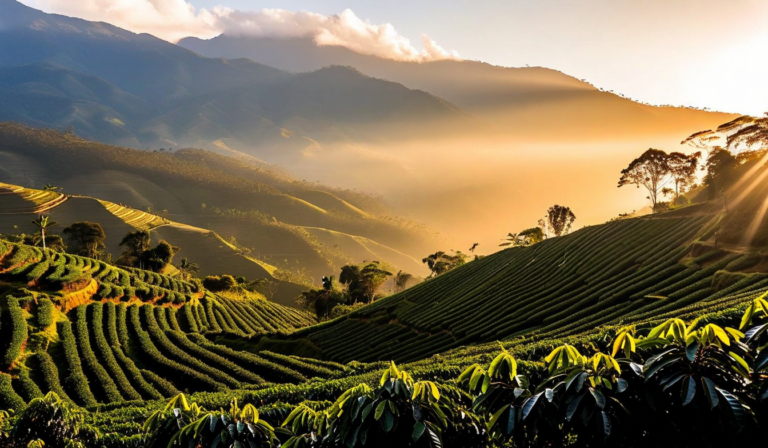
Huila and Narino are Colombia's two most recognized specialty coffee departments. Different elevations, different rainfall patterns, different soil profiles. Both producing world-class beans. We spent two growing seasons monitoring farms in both regions to see what satellite data revealed that traditional field monitoring missed.
The findings were more specific than we expected.
The two regions aren't as similar as they look
Both Huila and Narino produce coffee above 1,600 meters. Both have two harvests per year. But the climate behavior differs significantly. Huila's main growing zone around Pitalito and San Agustin has a more defined dry season, while Narino's coffee belt near La Union and Buesaco sits in a zone with more consistent rainfall driven by Pacific moisture.
For crop monitoring, this matters because pest pressure behaves differently. Coffee leaf rust (Hemileia vastatrix) requires humid conditions to sporulate and spread. In Huila, rust pressure typically spikes at the end of the rainy season when humidity stays high before the dry period begins. In Narino, rust pressure can be elevated across more of the year because humidity stays more consistent.
Standard spray schedules often treat both regions the same. Two years of satellite monitoring data showed clearly that they shouldn't be.
What satellite monitoring found that field inspection missed
On one 28-hectare farm in southern Huila, satellite passes in April 2024 revealed a band of consistently lower vegetation health scores running across a 200-meter elevation contour in the middle of the property. The lower half of the farm looked healthy. The upper half looked healthy. But this middle band, about 3 hectares of it, showed persistently weaker canopy density over six consecutive satellite passes.
The farm manager had noticed slightly lower yields from that zone in previous years but attributed it to older tree stock. The satellite pattern told a different story: the spectral signature was consistent with waterlogging stress rather than age-related decline.
A physical inspection confirmed it. A natural drainage channel that had been informally rerouted 15 years earlier was backing up during heavy rain events and saturating the clay-heavy subsoil in that elevation band. The trees weren't old and tired. They were chronically waterlogged for 4-6 weeks per year during peak rain.
Rerouting the drainage properly cost two days of labor. Yield from that zone increased 31% in the following harvest.
Rust pressure comparison across seasons
For the 2024 main harvest cycle, satellite-based stress alerts were sent to farms in both regions when early-stage rust pressure signatures appeared. Farms in Narino received alerts an average of 11 days before visible symptoms appeared on monitored plots. Farms in Huila received alerts 7-8 days before visibility.
The timing difference reflects the faster rust progression in Narino's higher-humidity conditions. Both provide workable lead time for intervention, but Narino farms needed to be prepared to act faster once an alert arrived.
Farms that acted on alerts within 48 hours of receiving them (targeted early spray of flagged zones) showed rust damage on an average of 4.2% of canopy at harvest. Nearby farms without alerts and without early intervention showed damage on 12.8% of canopy. The difference translates directly to yield and bean quality grade.
What this means for spray timing
The takeaway for Narino farms is that preventive fungicide application before the extended humid season starts makes more economic sense than reactive spraying because the rust window is longer. For Huila farms, targeted early intervention during the end-of-rainy-season risk window is sufficient for most years.
These are farm-level conclusions, not regional generalizations. The satellite data lets you see which specific plots in your farm are showing early stress, so you're treating the actual risk rather than an assumed one.