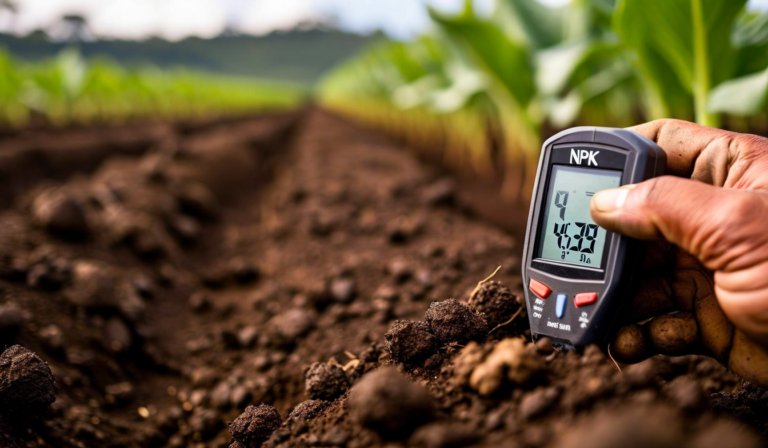
Nitrogen is the most applied nutrient in Colombian agriculture. It's also the most over-applied. Not because farmers are careless - because they're managing uncertainty without enough data. If you don't know how much is in your soil, you add more to be safe. The problem is that over-application above the plant's uptake capacity doesn't improve yield. It costs money and slowly degrades your soil biology.
The nitrogen cycle in three sentences
Nitrogen in soil exists in several forms. Nitrate (NO3-) and ammonium (NH4+) are the forms plants can actually absorb. Organic matter breaks down over time and releases nitrogen through microbial activity, but the rate depends on soil temperature, moisture, and pH. What's in a bag of fertilizer isn't all immediately available to your crop - some will mineralize gradually, some may leach below the root zone after heavy rain.
What deficiency vs. excess looks like for Colombian crops
Potato (Solanum tuberosum)
Nitrogen deficiency in potatoes shows first in older leaves: pale green to yellow coloration starting from the tips, working inward. Plants look thin and undersized at tuber initiation stage. Excess nitrogen produces the opposite: dark green, lush foliage that looks healthy but delays tuber set and increases disease susceptibility. A plant putting energy into leaves is not putting it into tubers.
Maize (Zea mays)
Maize nitrogen deficiency shows as a yellowing that starts at the leaf tip and moves down the midrib in a V-shape - the classic "fire" pattern. It's most visible on lower leaves first because the plant mobilizes nitrogen from older tissue to support new growth. Excess nitrogen here creates tall, lodging-prone plants that can topple under wind and rain load, which is a real yield-loss event in Cundinamarca's frequent afternoon storms.
Coffee (Coffea arabica)
Coffee is slower to show nitrogen deficiency visually. Uniform pale yellowing across the canopy, reduced branching, and smaller leaf size are the signs. Coffee responds well to well-timed nitrogen at two key stages: post-harvest when the plant rebuilds reserves, and at flowering when demand spikes. Over-application in between those windows is mostly waste.
How to read a soil nitrogen report
Soil nitrogen is typically measured in parts per million (ppm) or milligrams per kilogram (mg/kg). For Colombian highland soils and common crop types:
- Below 10 ppm available nitrogen: clearly deficient, applications needed before planting
- 10-25 ppm: marginal, supplemental nitrogen will likely pay off
- 25-50 ppm: adequate for most crop types at standard yield targets
- Above 50 ppm: sufficient or excess; additional nitrogen unlikely to improve yield
These are rough guides. The actual threshold depends on your specific crop, target yield, and growth stage. A maize crop at tasseling with 20 ppm available nitrogen needs different treatment than the same reading at V3 stage.
Timing matters as much as amount
Applying the right amount of nitrogen at the wrong time wastes most of it. A few key timing rules for Colombian conditions:
- Don't apply before heavy rain forecasts - nitrate leaches fast in sandy and medium soils under high rainfall
- Split applications: apply 30-40% at planting and the remainder at critical growth stages when demand is highest
- Don't apply when soil is saturated - denitrification converts soil nitrogen to gases that escape to the atmosphere
What zone-specific data changes
A farm using uniform nitrogen application across all zones based on a single soil sample is applying the wrong rate to most of its fields. Zone-specific data from multiple sensor locations consistently shows 30-40% variation in nitrogen levels across even small farms with similar crop history.
Farms on the Sioma platform using zone-specific fertilization recommendations reduced total nitrogen spend by an average of 22% in the first season - without any reduction in yield. The savings came entirely from not over-applying in zones that didn't need it.